AI Will Make Pop-Up Companies Normal
Small expert teams can now assemble around specific opportunities, ship faster, and share upside — but only if agreements, ownership, and payouts are structured from the start.
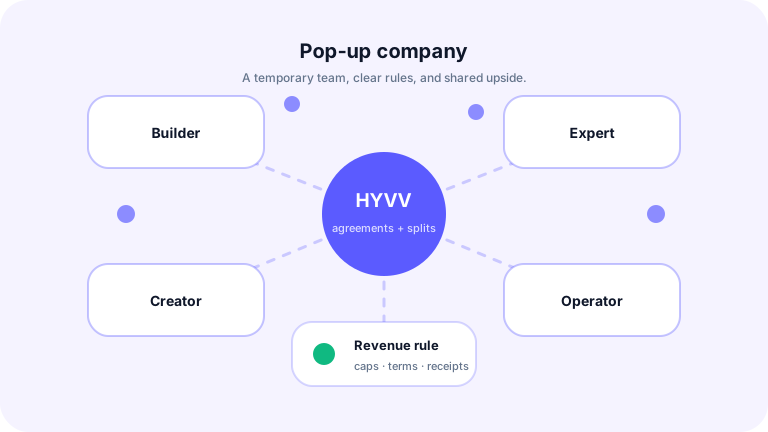
The company is getting smaller.
Not because ambition is getting smaller.
Because leverage is getting bigger.
AI is making it possible for small groups of talented people to produce what used to require departments: strategy, design, copy, code, support, research, marketing, automation, and analysis.
That does not mean every business becomes a solo project.
It means more businesses will look like pop-up companies: temporary, focused teams assembled around a specific opportunity, launch, product, client, channel, or work product.
The team forms.
The team ships.
The asset keeps working.
The upside needs to keep flowing.
What Is a Pop-Up Company?
A pop-up company is a structured collaboration around a specific economic outcome.
It might last:
- 30 days for a launch,
- 90 days for a productized service,
- 6 months for a niche tool,
- or 2 years for a recurring revenue project.
The key is that the team is not just trading hours.
They are building an asset.
Examples:
- a creator, designer, and operator launch a paid community,
- a developer, domain expert, and marketer ship a micro-SaaS,
- a consultant, AI engineer, and sales expert build a workflow product,
- a founder, creator, and distributor launch an Earn Link campaign,
- a coach, video team, and automation builder package a training product.
These do not need to become venture-backed companies.
But they do need clear rules.
Why AI Makes This More Common
AI lowers the coordination cost of starting.
A small team can now:
- research the market faster,
- draft the offer faster,
- prototype the product faster,
- write the landing page faster,
- create onboarding faster,
- build support systems faster,
- analyze customer feedback faster,
- and iterate faster after launch.
The bottleneck shifts away from raw production.
The bottleneck becomes:
- choosing the right opportunity,
- assembling the right people,
- defining the economics,
- building trust quickly,
- and making sure the upside is actually shared.
That last point is the one most teams miss.
The Pop-Up Company Failure Mode
Fast projects create fast ambiguity.
Everyone is excited. Everyone says they are aligned. Everyone wants to avoid slowing down.
So the team starts with vague terms:
- "We'll figure out the split later."
- "You'll get a piece if this works."
- "You're basically a partner."
- "Let's just launch first."
- "Revenue share should be easy."
That sounds collaborative until the asset starts making money.
Then every vague phrase becomes a liability.
Who gets paid? How much? For how long? From which revenue? Before or after expenses? What if the person stops contributing? What if the project pivots? What if it gets acquired? What if one channel works and another does not?
A pop-up company can move fast only if its rules are clear early.
The Minimum Rule Set
A good pop-up company does not need a massive legal stack.
It needs a minimum rule set.
| Rule | Question it answers |
|---|---|
| Role | What is each person responsible for? |
| Contribution | What work product or asset did they create? |
| Revenue source | Which money does the split apply to? |
| Split | What percentage or formula applies? |
| Duration | How long does the arrangement last? |
| Cap | Is there a maximum payout? |
| Maintenance | What happens if the work needs updates? |
| Exit | What happens if someone leaves or the asset is sold? |
| Receipts | How does everyone verify the payout history? |
That structure does not slow the team down.
It lets the team go faster without creating a trust bomb.
Example: A Four-Person Pop-Up Company
Imagine four people launch a niche AI workflow product for independent insurance agencies.
The team:
- Domain expert: knows the buyer, workflow, pain, and compliance edge cases.
- Builder: configures the AI workflow, integrations, and testing process.
- Creator: packages the offer, content, demos, and launch materials.
- Operator: handles onboarding, customer support, and weekly improvements.
They do not need a large company to test the idea.
They need:
- a clear project record,
- a revenue-share agreement,
- a way to route subscription revenue,
- payout rules,
- and receipts.
An illustrative split might look like:
- 40% company / treasury / reinvestment,
- 20% domain expert until $40k cap,
- 20% builder until $60k cap,
- 10% creator for 18 months,
- 10% operator while actively maintaining the system.
Those are not universal numbers. They are examples.
The point is that the structure can be specific, limited, and fair.
No one has to rely on "we'll remember."
Why This Is Different From Gig Work
Gig work is usually about completing tasks.
Pop-up companies are about creating assets.
That distinction matters.
A gig worker might be paid once to design a landing page.
A pop-up company contributor might earn a small residual from the landing page's attributed revenue for 12 months.
A gig worker might be paid once to write a playbook.
A pop-up company contributor might earn a capped share of revenue from the playbook product until the cap is reached.
A gig worker might be paid once to build an AI agent.
A pop-up company contributor might earn a per-account payout while the agent remains active.
The work is still scoped. The terms are still limited. But the economics recognize that useful work products can have an ongoing life.
Why Founders Should Care
Founders need better ways to recruit high-caliber contributors without pretending every collaboration requires full equity.
Equity is powerful, but it is blunt.
A pop-up company needs more flexible primitives:
- capped upside,
- time-limited revenue shares,
- product-specific splits,
- channel-specific splits,
- milestone-based payouts,
- maintenance-based payouts,
- and clear receipts.
That allows a founder to say:
I cannot give you 10% of the company, but I can give you 8% of the revenue from the product you help launch for 18 months, capped at $50,000, with automatic payout receipts.
That is much more precise.
It can be fair to the contributor and safe for the company.
Why Contributors Should Care
Contributors need better ways to turn great work into long-tail income.
A person with expertise, taste, or distribution can contribute far more than a deliverable.
They can create assets that keep working:
- offers,
- campaigns,
- funnels,
- automations,
- tools,
- templates,
- communities,
- operating systems,
- data products,
- AI workflows.
If those assets keep producing value, the contributor should be able to earn in a structured way after the initial delivery.
That does not mean every project deserves residuals.
It means the best projects should have the option.
How HYVV Fits
HYVV is built for the operating layer beneath these pop-up companies.
A team can define the project, clarify roles, generate agreements, set revenue-share rules, automate payout logic, and maintain a receipt trail.
That matters because the future of work will include more temporary teams and more long-tail work products.
The faster teams move, the more important it becomes to make the economics clear.
HYVV gives the team a shared record of:
- who contributed,
- what was promised,
- which revenue counts,
- how payouts are calculated,
- when terms expire,
- and what receipts prove.
The Point
AI will not eliminate collaboration.
It will make collaboration more fluid.
More teams will assemble around opportunities, ship quickly, and move on to the next asset.
The winners will not just be the people who move fastest. They will be the people who can move fast with clean terms, clear incentives, and automated trust.
That is the pop-up company era.
Ready to build with people without turning upside into ambiguity? Start with HYVV and give every pop-up company a structure, a revenue rule, and a receipt trail.
Want to see this run on a real company?
HYVV is the operating layer for ownership: structure agreements once, automate splits, and earn the verified HYVV CORP mark when your stack connects.
HYVV CORP · CERTIFIED
Bank✓Stripe✓Books✓