The Resume Is Being Replaced by the Work Ledger
In an AI-accelerated market, the best signal is not a prettier resume. It is a verified record of projects, agreements, outcomes, payouts, and receipts.
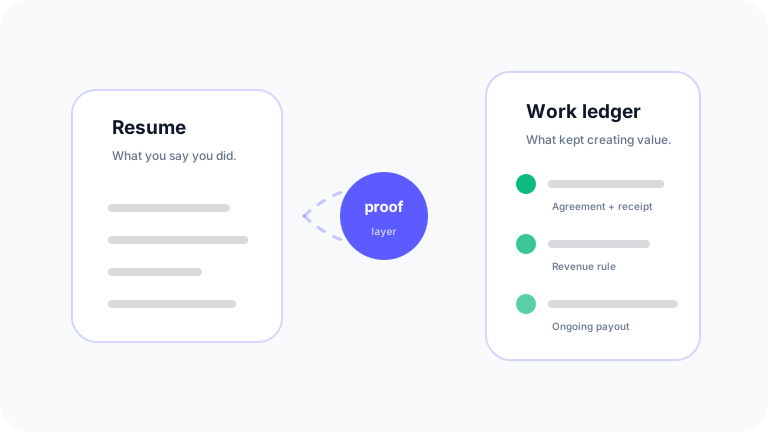
The resume was built for a slower labor market.
It was useful when the main question was simple:
Where did you work, what was your title, and how long did you stay?
That is still useful context. But it is becoming a weaker signal.
AI is making it easier for people to produce polished words, polished portfolios, polished case studies, polished mockups, and polished claims. The cost of looking credible is going down.
That means the market will start caring less about what you say you did and more about what your work actually did after it shipped.
The next career signal is not the resume.
It is the work ledger.
A Resume Describes the Past. A Work Ledger Proves the Past.
A resume is a story.
A work ledger is a record.
The difference matters because the future of work will be increasingly project-based. People will contribute to many ventures, products, automations, launches, templates, campaigns, workflows, and AI-enabled systems. Some of those contributions will keep creating value long after the person moves on.
A resume might say:
- Built a lead generation funnel.
- Designed a customer onboarding system.
- Created an AI support workflow.
- Helped launch a paid template product.
- Improved conversion rates.
A work ledger shows:
- what was built,
- who contributed,
- what agreement governed the work,
- which revenue stream it touched,
- what payout rule applied,
- what receipts were created,
- and what changed over time.
The resume says, "Trust me."
The ledger says, "Here is the trail."
Why This Matters More Because of AI
AI compresses output time.
A sharp person can now move faster through drafts, prototypes, support scripts, landing pages, research, documentation, workflows, and analysis. That is a massive advantage for builders.
But it also creates noise.
When more people can produce more artifacts, the market needs a better way to identify which artifacts actually mattered.
The old signal was activity:
- I was on the team.
- I attended the meetings.
- I contributed to the launch.
- I worked at the company.
The new signal is outcome:
- This work product shipped.
- This rule connected it to revenue.
- This agreement defined the contributor's upside.
- This payout happened because the work kept performing.
- This receipt proves the contribution had an economic life.
That is a different type of credibility.
What Belongs in a Work Ledger
A useful work ledger does not need to be complicated. It needs to answer the questions that actually matter.
| Ledger field | Why it matters |
|---|---|
| Work product | Defines the actual asset created |
| Contributor role | Shows what the person was responsible for |
| Agreement | Proves the terms were written down |
| Revenue or value source | Shows where the upside comes from |
| Split, cap, or duration | Prevents vague promises |
| Payout history | Shows whether the rule actually paid |
| Receipts | Creates proof for both sides |
| Change history | Shows what changed and why |
This is not about turning every project into bureaucracy.
It is about making work legible.
If a project keeps making money, saving money, attracting leads, retaining users, or driving growth, the people who created it should have a record that survives beyond the launch date.
The Career Value of a Ledger
A ledger changes how a person can present themselves.
Instead of saying:
I am a designer who has worked on landing pages.
They can say:
I created three landing pages with capped revenue-share agreements. Two are still active. One generated monthly payouts for 14 months. Here are the receipts.
Instead of saying:
I am good at AI automation.
They can say:
I built five internal AI workflows. Three reduced support load, one powered a paid service, and one expired after reaching its payout cap.
That is a much stronger signal.
The worker is no longer only selling labor.
They are proving that their work can become an asset.
The Company Value of a Ledger
This helps companies too.
Companies need better ways to answer:
- Who helped build this asset?
- What did we promise them?
- Are we still obligated to pay them?
- Has the cap been reached?
- What revenue counts?
- Can we prove the payout history?
- Can we explain this during diligence, a sale, or a dispute?
Without a ledger, every question becomes a scavenger hunt through contracts, spreadsheets, emails, DMs, Stripe exports, and someone's memory.
That is not scalable.
A work ledger gives the company a cleaner operating history.
It also lets the company attract better contributors because the contributor knows the promise will not disappear into a folder.
Why This Connects to Micro-Residuals
A work ledger matters most when the work has a residual economic life.
If someone completes a one-time task with no ongoing value, a normal invoice may be fine.
But if someone creates a work product that keeps producing revenue, savings, leads, or retention, the payment model should be able to reflect that.
That could mean:
- a small percentage of revenue,
- a capped split,
- a time-limited residual,
- a per-user payout,
- a savings-based payout,
- or a payout until a target return is reached.
The problem is that micro-residuals are hard to manage manually.
That is why the ledger matters.
The ledger is what makes tiny, ongoing payments understandable instead of chaotic.
The Resume Will Not Disappear. It Will Lose Power.
People will still have resumes.
But the best opportunities will go to people who can show more than title history.
The highest-leverage workers will be able to show:
- They know how to create useful assets.
- They know how to structure fair upside.
- They can prove past work kept creating value.
- They understand how to collaborate with founders, creators, operators, and AI tools.
- They can bring receipts, not just claims.
That is the shift.
The resume is a snapshot.
The ledger is a living economic record.
How HYVV Makes the Work Ledger Possible
HYVV is built around the pieces a ledger needs:
- company setup or import,
- contributors and owners,
- agreements,
- revenue-share rules,
- payout logic,
- receipts,
- and a transparent record of what happened.
When a contributor creates something valuable, HYVV helps turn the promise into a structured agreement and the ongoing value into a trackable payout rule.
That means the company is not relying on memory.
The contributor is not relying on trust alone.
Both sides can see the record.
The Point
AI makes output cheaper.
Proof becomes more valuable.
The people who win will not only be the people with the best resumes. They will be the people with the strongest body of work and the cleanest proof that their work created value.
The future career asset is a ledger of useful work that kept paying.
Ready to turn work into proof? Start with HYVV and create a record of agreements, revenue rules, payouts, and receipts around every valuable project.
Want to see this run on a real company?
HYVV is the operating layer for ownership: structure agreements once, automate splits, and earn the verified HYVV CORP mark when your stack connects.
HYVV CORP · CERTIFIED
Bank✓Stripe✓Books✓