Work Should Compound, Not Expire
The old job market treats work like it disappears after payday. AI makes more durable work products possible — and HYVV helps those assets keep paying.
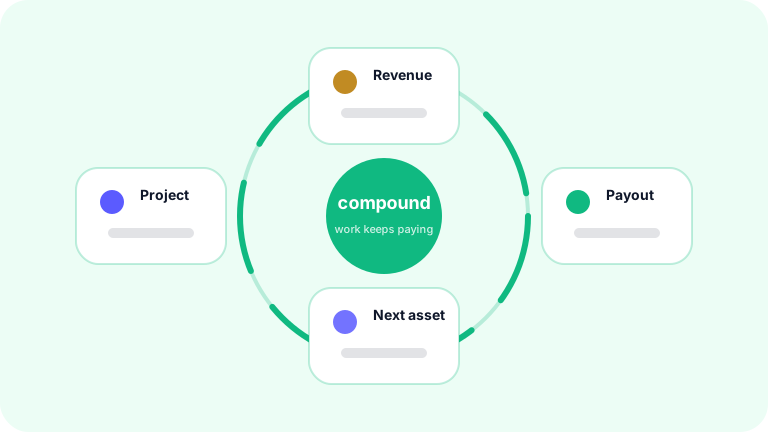
Most work expires too quickly.
A person builds something valuable. They get paid once. The company keeps using the asset. The asset keeps producing value. The worker moves on.
That has been normal for a long time.
But normal does not mean optimal.
In a world where AI helps people create more useful work products faster, the economic structure needs to catch up.
Work should not always expire after payday.
The best work should compound.
The Expiring Work Problem
The old model is simple:
- Do the work.
- Get paid.
- The company owns the result.
- The worker starts over from zero.
That can be fine for routine tasks.
But it breaks down when the work becomes an asset.
Examples:
- a funnel that keeps generating customers,
- an automation that keeps saving labor,
- a template that keeps selling,
- a support system that keeps reducing tickets,
- a training module that keeps improving retention,
- a product feature that keeps driving upgrades,
- an AI workflow that keeps executing a business process.
Those work products do not expire.
They keep working.
The payment structure should be able to keep recognizing the value they create.
AI Makes More Work Compoundable
AI changes the economics of building.
It makes it faster to go from insight to artifact.
A person with expertise can use AI to create:
- a first version,
- a prototype,
- a playbook,
- a productized service,
- a landing page,
- a workflow,
- a knowledge base,
- a training system,
- an AI agent,
- or a repeatable operating process.
That means more people can create more assets.
But speed alone is not enough.
If every AI-accelerated project is still paid like a one-time task, the worker has no compounding effect. They are faster, but they are still stuck restarting their income every month.
That is not true leverage.
True leverage means the work keeps producing value while the person is free to create the next thing.
The Compounding Work Flywheel
A better model looks like this:
- Create a valuable work product.
- Attach it to a clear revenue or value source.
- Define a small residual rule.
- Automate payouts and receipts.
- Use the income to buy time, stability, and better choices.
- Build the next asset.
That is the flywheel.
The key is that the person is not only stacking tasks.
They are stacking assets.
A Small Example
Imagine a contributor builds three assets in one year:
| Asset | Residual rule | Monthly income after launch |
|---|---|---|
| Landing page funnel | 3% of attributed revenue for 18 months | $850 |
| AI onboarding workflow | $2 per active account, capped at $20k | $1,150 |
| Paid template library | 15% of net sales | $620 |
| Total | $2,620/month |
That is not enough to replace every job.
But it is enough to change the contributor's options.
It can cover rent in some markets. It can reduce dependence on a bad client. It can finance another project. It can buy time to make better decisions.
Now imagine the contributor does this for three years and only half the projects survive.
That can still become meaningful.
The compounding effect does not require every project to be a breakout.
It requires enough useful work products to keep paying in small amounts.
Why This Is Better Than Chasing Only Bigger Paychecks
A raise is useful.
A better job is useful.
But both still usually depend on one buyer of your labor.
Compounding work creates a different kind of income:
- it is diversified,
- it is tied to past value,
- it can continue while you do new work,
- and it can grow independently of a title change.
The point is not to reject jobs.
The point is to stop relying on jobs as the only economic path.
A healthy future income stack might include:
- salary or client income,
- project residuals,
- owned products,
- equity or ownership,
- partner revenue shares,
- and cash reserves.
The person with that stack is harder to trap.
They can take creative risks.
They can walk away from bad terms.
They can choose better projects.
The Human Role Gets More Valuable
AI can help produce artifacts.
But humans still decide what should exist.
The valuable work is often the judgment layer:
- knowing the customer,
- identifying the painful workflow,
- framing the offer,
- designing the experience,
- choosing the right promise,
- building trust,
- and refining the product until people actually use it.
That is why compounding work is not just about automation.
It is about human expertise turned into durable assets.
If the human contribution is what makes the asset useful, the human should be able to participate in the asset's upside in a clear and limited way.
Why Most Teams Do Not Do This Yet
The reason is not philosophical.
It is operational.
Compounding work requires answers to annoying questions:
- What exactly was created?
- Who contributed to it?
- What revenue or value does it affect?
- What percentage applies?
- Does the payout expire?
- Is there a cap?
- What happens if the work product changes?
- What if the contributor stops maintaining it?
- How does everyone verify the math?
If those questions are answered in a spreadsheet, the system breaks.
If they are answered in a handshake, trust breaks.
If they are answered in a contract that no system reads, the payout process breaks.
That is why the future of compounding work needs a structured operating layer.
The Company-Safe Version
Companies do not want unlimited obligations.
They should not create them accidentally.
The company-safe version of compounding work uses constraints:
- capped payouts,
- time-limited terms,
- narrow revenue definitions,
- maintenance conditions,
- termination triggers,
- and transparent receipt trails.
That gives contributors upside without turning every project into permanent equity.
It also lets companies reward outcomes without losing control of the entire business.
A good residual agreement should feel precise, not vague.
The Contributor-Safe Version
Contributors do not want vague promises.
They need to know:
- what they earn from,
- how it is calculated,
- when they get paid,
- what the cap is,
- what happens if the company pivots,
- and how they can verify receipts.
A contributor should never have to ask, "Did you remember to pay me?"
If the work keeps creating value, the payout should flow from the rule.
How HYVV Helps Work Compound
HYVV gives founders and contributors the structure to make work compound without manual chaos.
The platform is built around:
- agreements,
- revenue-share rules,
- ownership and contributor records,
- payout logic,
- caps and durations,
- and receipt trails.
That means a valuable work product can have a financial life after launch.
The company can define exactly what applies.
The contributor can see exactly what was promised.
The payout can happen without becoming another admin project.
The Point
AI makes more useful work products possible.
But faster work is not enough.
The real shift happens when useful work becomes durable and durable work can keep paying.
That is how people move from earning only from today's labor to earning from a growing body of past work.
That is how small residuals become meaningful.
That is how work compounds instead of expiring.
Ready to make valuable work durable? Start with HYVV and create agreements, payout rules, caps, and receipts around the assets your team builds.
Want to see this run on a real company?
HYVV is the operating layer for ownership: structure agreements once, automate splits, and earn the verified HYVV CORP mark when your stack connects.
HYVV CORP · CERTIFIED
Bank✓Stripe✓Books✓