The founder admin stack is a tax
Formation, agreements, cap tables, revenue splits and payouts in five different tools cost founders weeks. Here's what belongs in one flow instead.
Nobody starts a company to do admin.
But the admin arrives anyway. You set out to build, sell and create value, and soon you are also the legal department, the finance team, the payroll clerk and the person who remembers what everyone was promised.
Every tool solves one slice. None of them hold the whole company.
That is the founder admin tax.
The stack nobody meant to build
An early-stage company can end up with all of this before it has meaningful revenue:
- One tool for formation
- Another for contracts
- A spreadsheet for the cap table
- A different spreadsheet for revenue shares
- Stripe for payments
- A folder of signed PDFs
- Email threads for approvals
- A notes app for decisions
- A calendar reminder for compliance
- The founder's memory, holding it all together
Each piece is reasonable. Together, they become a tax.
The cost isn't just subscription fees. It's attention.
Context switching is a company problem
When the company's records are scattered, every important question becomes a search:
- Who has an agreement?
- What percentage did we promise?
- Has the cap been reached?
- Which revenue counts?
- Did the payout happen?
- Where is the receipt?
- What changed since last month?
The founder becomes the integration between disconnected systems. That works for a week. It doesn't work as an operating model.
The trust gap
Manual admin does more than waste time. It opens trust gaps.
A contributor who can't see their terms has to trust your memory. A partner who can't check a payout has to trust your spreadsheet. A co-founder who can't trace ownership changes has to trust old conversations.
Trust is good. Blind trust is expensive. The more people you involve, the more the records need to explain themselves without you narrating them.
What belongs in one flow
These shouldn't be separate administrative worlds:
Formation
The company starts with a structured record: the entity, the owners, their roles and the core operating details.
Agreements
If someone earns ownership or revenue, the terms become a signed document, not a memory.
Cap table
Ownership updates from the same facts that created it, without a second spreadsheet to maintain.
Revenue rules
Splits, caps, the order of payment and end dates are rules that run, not notes in a PDF.
Payouts and receipts
When revenue arrives, the split is calculated, the money moves and the record is kept, without anyone retyping a number.
That isn't extra process. It's the same process, connected.
How HYVV connects it
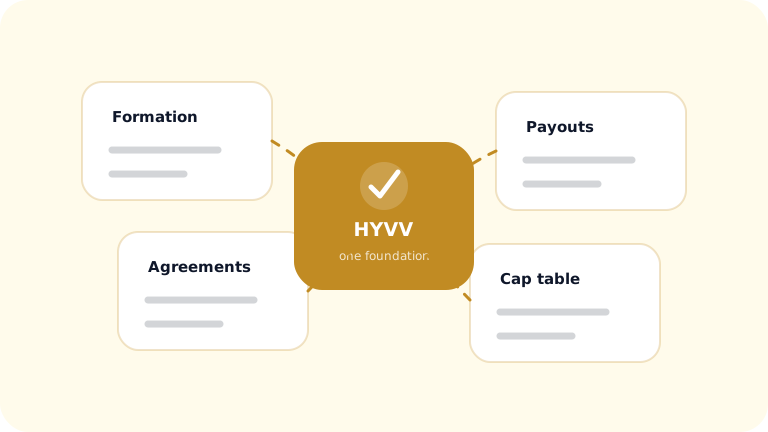
HYVV is the foundation those pieces sit on. Hyper Formation forms the company, Agreements drafts the terms and gathers the signatures, the Cap Table holds equity and revenue shares on one record, and Revenue Sharing splits each payment and keeps the receipt tied to the terms that created it. The home page shows how the whole foundation fits together.
What that removes:
- A separate payout calculator
- A folder of agreements nobody can find
- A cap table that drifts from the documents
- Contributors asking whether they were included
- Rebuilding the company's story every time someone needs an answer
HYVV doesn't make operations disappear. It makes them visible, structured and able to run.
The same structured record matters for the AI tools you'll bring in. We cover that in why AI needs a company source of truth.
A five-question admin audit
If the company feels heavier than it should, ask:
- How many tools do I open to explain who owns what?
- How many do I open to prove a payout?
- How many promises exist outside signed agreements?
- How many spreadsheets would break if I stopped maintaining them?
- How many questions can only be answered by asking me?
Every "too many" is part of the tax.
Small enough to run alone
Early founders shouldn't need a full back office to share value with the people who help build the company. The admin stack should be small enough to run alone and strong enough to survive growth.