AI needs a company source of truth
An AI assistant can't run on scattered docs and stale spreadsheets. It needs linked company records: owners, agreements, rules, payments and receipts.
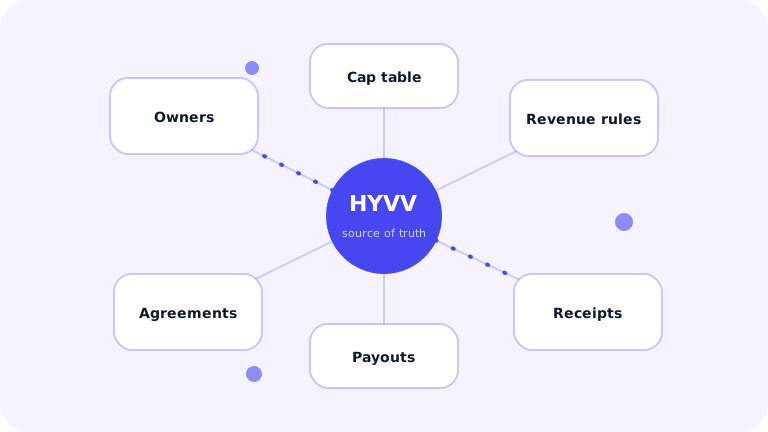
AI is only useful when it knows what is true.
That sounds obvious until you ask it a business question:
- Who should get paid from this revenue?
- Which contributors have active agreements?
- What changed in the cap table?
- Did this payout match the terms?
- Which ownership promise is still undocumented?
A general-purpose assistant can write a confident answer. It can't guarantee that the answer matches your company.
The difference is whether the model is reading your company's records or guessing from fragments.
The common mistake
Many AI experiments start with scattered context. A founder pastes in a contract, then a spreadsheet, then a Stripe export, then an email thread, then a few notes about who helped with what.
The model can summarize the pile, but the pile isn't a system. If the underlying records are fragmented, the AI inherits the fragmentation:
- It doesn't know which document is current.
- It can't tell whether a spreadsheet reflects signed terms.
- It can't connect a payment to a payout rule unless that link is recorded.
- It can't tell a promise from an agreement.
- It can't check what it can't see.
AI doesn't fix a missing source of truth. It exposes it.
What a company source of truth includes
For a founder, the source of truth isn't a document library. It's structured company data:
- The entity: which company exists and how it is set up
- The owners: who holds a stake, and why
- The agreements: which terms have been signed, and which version is current
- The revenue rules: who shares in revenue, at what percentage, with what cap or end date
- The payout ledger: what money moved, when and why
- The receipts: proof that each payout followed its rule
That is the context any assistant (or new hire, or accountant) needs before it can be useful.
Why structure beats storage
A folder can store a signed agreement. It can't apply it.
A spreadsheet can track a revenue split. It can't show that the split matches the signed terms.
A chat thread can explain a decision. It can't keep that decision attached to the cap table and the payout rules.
What matters is the relationships, not just the files: this agreement created this ownership record, this rule applies to these payments, this receipt belongs to this contributor.
What linked records make possible
When the facts are connected, questions that used to need the founder's memory can be answered from the record, whether the person asking is a co-founder, your accountant or an AI tool you have given access to.
What changed?
Changes to owners, agreements and revenue rules are recorded in one place, so a summary comes from the record instead of from memory.
Who needs attention?
Unsigned agreements, missing payout set-up and shares nearing their cap are visible as data instead of being buried in email.
Can I trust this payout?
The path from payment to rule to receipt is explicit, so it can be explained instead of reconstructed from a spreadsheet row.
What should happen next?
Decisions start from the company's current state, not from last quarter's document.
Where HYVV fits
HYVV keeps those records linked: formation, ownership, agreements, revenue rules, payouts and receipts live on one record. Every money movement is written to a hash-chained ledger that is re-verified every night, so any later change is detectable (tamper-evident).
For the day-to-day cost of running all this across separate tools, read the founder admin stack is a tax.
Give AI a source of truth
Don't ask AI to be the source of truth. Give it one.
When the company lives in disconnected tools, AI becomes one more place to copy and paste confusion. When the records are structured and linked, it becomes a faster way to find what is already true.