Micro-residuals: paying for work that keeps earning
A micro-residual is a small, capped revenue share tied to one piece of work. How to scope one, a worked example, and what HYVV can run today.
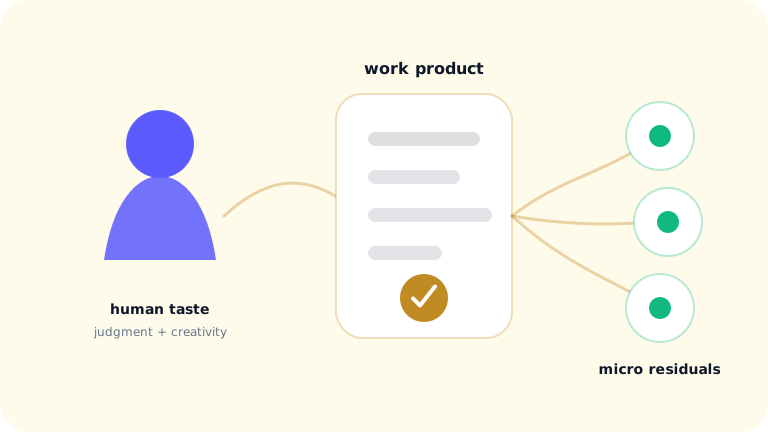
Some work is finished when it ships. Some keeps earning: a checkout page that converts for a year and a half, a template that keeps selling, a partner channel that keeps sending customers. Paying for the second kind with one invoice leaves the person who made it out of the value it keeps creating — and gives them no reason to care once it launches.
A micro-residual is one answer: a small, structured revenue share tied to one piece of work, with a cap or an end date so it can't grow into an open-ended obligation. For why this matters more as AI makes first drafts cheap, see work should compound, not expire. This post is about how to set one up.
Where micro-residuals fit
| Payment | What it pays for | How long it lasts |
|---|---|---|
| Invoice | A deliverable, once | Paid on delivery |
| Micro-residual | A small share of the revenue a piece of work helps earn | Until a cap or an end date |
| Equity | Ownership, for long-term, company-wide contribution | Until the shares are sold or repurchased |
Work that tends to fit:
- a landing page, funnel or checkout tied to sales,
- a paid template, add-on or course module someone designed,
- a partner or distribution channel someone opened,
- a launch kit sold on its own.
Work that saves money rather than earning it — an automation that cuts support load, say — is a poor fit for a revenue share. Pay it with a fee or a bonus instead.
Six decisions to make before the work starts
- The work product. Name exactly what earns the residual, so nobody argues later about which version counts.
- The revenue it's tied to. Decide which revenue counts. Attributing sales to one page or one channel is hard to prove; a smaller share of all company revenue is often simpler and easier to verify.
- The percentage. Small is fine. The point is a fair link to the value created, not a windfall.
- The cap. The most the company will ever pay under this residual.
- The end date. When the residual stops, even if the cap hasn't been reached.
- What happens if the work changes. Whether the contributor is expected to maintain it, and what happens if it is replaced, retired or sold.
Write all six into the agreement, and agree how the contributor will see what they've been paid.
A worked example
Neon Labs hires Priya Raman, a designer, to rebuild its checkout. Instead of one larger fee, they agree to:
- a smaller fixed fee for the build, and
- 2% of Neon Labs' revenue for 12 months, capped at $6,000.
If Neon Labs brings in $20,000 in a month, Priya's share that month is $400. The residual ends after 12 months or once $6,000 has been paid, whichever comes first. At that pace it reaches its end date first, having paid $4,800. It is one of three shares in Priya's own record in work that keeps paying.
Illustrative example.
Why small residuals need a system
One residual is easy to track. Several, across several contributors, each with its own percentage, cap and end date, is a lot of arithmetic that has to be right every month. Done by hand, it drifts, and the people being paid can't check it. That is where most residual promises quietly fail.
What HYVV runs today
HYVV automates the revenue-percentage version of a micro-residual:
- A percentage of revenue. Each share in Revenue Sharing is a percentage of the gross revenue that settles in your company's Stripe account, paid until it reaches its dollar cap or its end date.
- An offer in one link. For someone outside the company, an Earn Link turns the residual into a link they claim with a signature. You set the share (0.1% to 50% of gross revenue), an optional cap on what each person who claims it can earn, and how long the link stays open.
- A receipt for every payout. Both sides can see each payout and verify its receipt by link.
Per-unit residuals ("$1 per active customer") and savings-based residuals aren't calculated by HYVV. Write those as fees, or convert them into a revenue percentage both sides accept.